Get Free Ebook Indonesia, Etc.: Exploring the Improbable Nation, by Elizabeth Pisani
You could alter your mind to be better after obtaining the sources from some files. But when you have the resources from this book, you can take just how various this book sight from others. Yeah, this is exactly what makes you feel finished to get over the function of the resources. Indonesia, Etc.: Exploring The Improbable Nation, By Elizabeth Pisani becomes one recommendation that provides the presence of new info and suggestions. Currently, your time is for getting the book quicker. This is it the book that you need now!
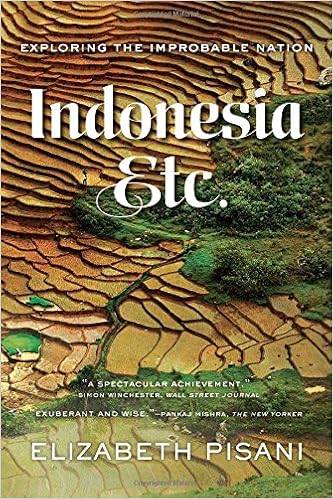
Indonesia, Etc.: Exploring the Improbable Nation, by Elizabeth Pisani

Get Free Ebook Indonesia, Etc.: Exploring the Improbable Nation, by Elizabeth Pisani
Read more as well as get wonderful! That's what the book entitled Indonesia, Etc.: Exploring The Improbable Nation, By Elizabeth Pisani will certainly offer for every single visitor to read this book. This is an on-line publication provided in this web site. Also this book ends up being a choice of someone to check out, numerous in the world likewise enjoys it a lot. As just what we speak, when you read more every page of this book, what you will certainly get is something terrific.
And here, that book is Indonesia, Etc.: Exploring The Improbable Nation, By Elizabeth Pisani, as you need it adapting the topic of your obstacles. Life is challenges, jobs, and also responsibilities are additionally difficulties, and also there are lots of things to be difficulties. When you are definitely baffled, just get this publication, as well as select the essential info from the book. The content of this could be made complex as well as there are several styles, but reading based upon the topic or reading page by web page can assist you to recognize just that publication.
While the other individuals in the shop, they are uncertain to find this Indonesia, Etc.: Exploring The Improbable Nation, By Elizabeth Pisani straight. It could require more times to go store by store. This is why we mean you this site. We will certainly supply the very best means as well as referral to obtain the book Indonesia, Etc.: Exploring The Improbable Nation, By Elizabeth Pisani Even this is soft file book, it will certainly be convenience to bring Indonesia, Etc.: Exploring The Improbable Nation, By Elizabeth Pisani anywhere or conserve in the house. The difference is that you could not require relocate guide Indonesia, Etc.: Exploring The Improbable Nation, By Elizabeth Pisani area to location. You may require just duplicate to the various other tools.
The selection of you to read this publication is not based on the force to read it. it will start to make you really feel that this book is really correct to review in this time. If often you will additionally create your concepts right into a book, learning kind this publication is an excellent way. Indonesia, Etc.: Exploring The Improbable Nation, By Elizabeth Pisani is not just the reading publication. It is a book that has amazing experience of the globe. The book motivates to obtain better future. This is the reason why you need to read this book, also the soft data publication, you could get it. This is exactly what you require now to test your idea of habit.
"A spectacular achievement and one of the very best travel books I have read." ―Simon Winchester, Wall Street JournalDeclaring independence in 1945, Indonesia said it would "work out the details of the transfer of power etc. as soon as possible." With over 300 ethnic groups spread across over 13,500 islands, the world’s fourth most populous nation has been working on that "etc." ever since. Author Elizabeth Pisani traveled 26,000 miles in search of the links that bind this disparate nation. Map; 25 illustrations
Your recently viewed items and featured recommendations
›
View or edit your browsing history
After viewing product detail pages, look here to find an easy way to navigate back to pages you are interested in.
Product details
Paperback: 416 pages
Publisher: W. W. Norton & Company; 1 edition (June 22, 2015)
Language: English
ISBN-10: 0393351270
ISBN-13: 978-0393351279
Product Dimensions:
5.4 x 1 x 8.3 inches
Shipping Weight: 7.2 ounces (View shipping rates and policies)
Average Customer Review:
4.5 out of 5 stars
125 customer reviews
Amazon Best Sellers Rank:
#169,254 in Books (See Top 100 in Books)
If you're like most Americans, chances are you know little or nothing about Indonesia. Yet that island nation is the world's fourth largest by population (after China, India, and the USA) and fifteenth largest by land area (just after Mexico). It also is home to the world's largest population of Muslims. Indonesia consists of "a string of 13,466 islands inhabited by people from over 360 ethnic groups, who between them speak 719 languages." If armchair exploring appeals to you, then you'll love Indonesia Etc., Elizabeth Pisani's memoir of her 13-month journey through what she terms "the improbable nation."No run-of-the-mill travel writerPisani is no run-of-the-mill travel writer. She lived in Indonesia for three years as a reporter for Reuters (1988-91) and returned for another four-year stay a decade later after training as an epidemiologist specializing in AIDS. (Today, Pisani runs a public-health consultancy in London.) It's clear from context in the book that she is fluent and comfortable in the lingua franca of the islands, Indonesian. Equally important, Pisani is one tough lady. Even as a youngster, I wouldn't have dreamed of subjecting myself to the rigors of her 13-month odyssey.Colorful and engaging anecdotesIndonesia Etc. is full of colorful and engaging anecdotes of the sort that will be familiar to anyone who has traveled extensively in the Third World. There is, for example, a hilarious tale of a Crocodile Whisperer, a shaman who presented himself as able to persuade the crocodiles in one region to identify and shun the one beast in their midst that had eaten a local woman. In other tales, Pisani recounts her experiences wearing the wrong batik design to the coronation of a local sultan and with a Koran-reading contest. "Koran-reading contests are as popular in Indonesia as visits by Manchester United's touring team."Then there was her effort to travel from small island to another. "'Is there a schedule for the boat to Lonthor?' I yelled across to the boatmen. 'Of course!' they yelled back. 'When do you leave?' I bellowed. 'When the boat is full!' came the reply."Pisani emphasizes again and again the warm hospitality and sense of humor she encountered everywhere in Indonesia. After casual meetings on boats or buses, local people unhesitatingly invited her to live with them in their homes and share their food for days on end. Just imagine that happening in New York or Los Angeles!Indonesia's blood-soaked historyIn Indonesia Etc., Pisani delves deeply into the history, politics, and economics of Indonesia. Amid her tales of days spent in tiny settlements or on leaky, slow-moving boats from island to island, she explores the history of this extraordinarily diverse and rich nation. Most of the time since the country gained independence from the Dutch in 1945 Indonesia has been dominated by two men whose legacies remain evident to the present day: Sukarno (1945-67) and Suharto (1968-98). Pisani recounts their years with rich detail about the tumultuous times during which they presided over the nation.One event stands out: the massacre that brought Suharto to power. In the course of three years, at least half a million, and as many as three million Communists, ethnic Chinese, and alleged leftists were brutally murdered. Hundreds of thousands more were raped, driven from their homes, or saw their businesses destroyed.As Pisani writes, "The carnage wiped out a whole generation of socially committed activists and pulled up the roots from which they might regrow. It crippled the development of political debate and made Indonesian citizens wary of political allegiance." For decades afterward, the Indonesian military ran rampant through the breakaway provinces of East Timor and Aceh as well as other regions that sought independence for themselves.Indonesia today: one of the world's most decentralized nationsFrom Pisani's perspective, Sukarno and Suharto followed radically divergent political paths. Sukarno moved to centralize government, imposing rigid control from the country's most populous island (Java) on the rest of the country and launching a satellite to carry news in the Indonesian language throughout the archipelago. Suharto initiated decentralization, devolving power onto local government."At a stroke," Pisani writes, "the world's fourth most populous nation and one of its most centralized burst apart to become one of its most decentralized. The centre still takes care of defence, fiscal policy, foreign relations, religious affairs, justice and planning. But everything else—health, education, investment policy, fisheries and a whole lot more—was handed over to close to 300 district 'governments,' whose only experience of governing had, until then, been to follow orders from Jakarta."In myriad ways, Pisani shows how the move to decentralization has been a disaster for Indonesia. When she wrote her book in 2012, the number of district governments had grown to 509, virtually every one of them a fiefdom for the local elite and rife with corruption. ("'Papua's wealth used to be stolen by Jakarta. Now it's stolen by the Papuan elite.'") Yet, as Pisani takes pains to point out, "No other nation has welded so much difference together into so generally peaceable a whole in the space of less than seventy years."Indonesia's endemic corruptionAs the author explains, "A small fraction of jobs in the bureaucracy are awarded based on competitive exams. But most of the jobs that are not given out to political supporters get sold . . . The minister in charge of the 'state apparatus' recently said that 95 percent of Indonesia's 4.7 million civil servants didn't have the skills they needed to do their jobs." Many Indonesians attribute their country's endemic corruption to the legacy of Dutch colonialism. Compared to the English, the Dutch provided few educational opportunities for their subjects. However, Indonesia has been independent for seven decades. Blaming colonialism is a bit of a stretch.An "improbable nation?"Pisani subtitles her book Exploring the Improbable Nation. She makes clear that Indonesia's unmatched diversity, island geography, and complex history could well have resulted in many different countries rather than one. There's no disputing this. However, to a somewhat lesser degree, the same might be said of many of the European countries that are generally regarded as the most stable and logical nation-states in the world: Italy, Germany, France, Spain, even England. Dig beneath the surface in any one of these countries, and you'll find the nation-building that occurred in centuries past was anything but an inevitable outcome. All these countries are rife with regional differences in culture, history, and even language. To be sure, the regional differences are by no means as stark as they are in Indonesia, but it would be a mistake to assume that the emergence of these countries as unitary political units was foreordained.
Former Reuters journalist Elizabeth Pisani has been living in Indonesia for the majority of her adult life, stretching back since the 1980s.She speaks fluent Indonesian, used to drive around Jakarta riding a motorcycle and now in this book she travels around Indonesia - from NTT, to the eastern islands around Maluku, to the big islands of Sulawesi, Sumatra, Kalimantan then the "main island" of Java - visiting the remotest regions, blending-in with the locals, even participating in numerous hard-labour works and various local festivals along the way (I'm still curious on what she did with that "request" in Mount Kemukus).In every part of the nation that she visits, she describes the local customs, social hierarchy and economy in great detail. She also elaborates on the many problems facing with every single village, island and province - from corruption, exploitation, poverty, inequality, to transportation, infrastructure and even cultural problems.And between the fascinating local stories she also give various facts, statistics and history of this great country to give us the bigger picture ("The ties that binds" chapter, in particular, is world class), and shows how the Indonesia that we thought we always knew, and the Jakarta-centric (and java-centric) one we see daily in national TV, is perhaps just 1/10th of the actual country.Unlike any other western books on Indonesia - like special chapters in John Pilger's New Rulers of the World, Naomi Klein's Shock Doctrine, John Perkins' Confessions of an Economic Hit Man, and even Andre Vltcheck's Indonesia: Archipelago of Fear - who tend to have a brilliant but one-sided view, Elizabeth Pisani can show both the good side and bad side of nearly everything Indonesian and then elaborate in great detail on how it work out in reality.For example, the many corruptions in the country are rightly seen as a bad epidemic by many, but Pisani also acknowledged it as one of the unlikely ties that weirdly binds the nation together, as a "new normal" way of life, whether we like it or not. Furthermore, like many authors before her Pisani portrays founding father Soekarno as a great charismatic leader, but she also pointed out the messiness of his presidency later on that led to a hyperinflation. She also portrays the "32 years dictator Soeharto" as a great leader that brilliantly tied the diverse nations together for the first 20 years of his presidency, but started to look "dictatorial" (with every stereotypes that come with the label) after his kids grew up.Indeed, reality is a hard-to-swallow concept for a complex country like Indonesia, where the line between right or wrong, and taboo or normal are often blurry. And in this book Pisani taught us that we need to see the many different issues facing the country from many unfiltered angles to really understand what the country is all about. The underlying truth about Dayak-Madura ethnic conflict in Kalimantan, the "religious" violence in Maluku, and the birth of Police-backed extremist group FPI, for instance, are different compared with the way the mainstream media are describing.With that in mind, this book is truly an eye opener, a well-balanced Rosetta Stone for my Western-educated train of thoughts and values, which often struggles to understand the complex reality of my own country. Not anymore.
Elizabeth Pisani's book Indonesia, Etc. (2014) is an entertaining and informative look at the island kingdom. Pisani has spent two long stints in Indonesia, first as a journalist in the late 80s and then more recently as an AIDS consultant with the Indonesian government. Furthermore, she speaks Bahasa fluently, which allows her to communicate with people from all walks of life. The fact that she was a divorced, childless woman who was atheist made it difficult for some Indonesian to relate to her which sometimes led to white lies that sometimes came so burdensome she went back to the truth. Her year long itinerary included a host of isolated and lesser known island along withe largest such as Java that are the homes of the largest percentage of the population. Along the way she uses interactions with people to segue into discussions about race, religion, politics, corruption, law and commerce among other thoughtful well-informed observations about contemporary Indonesian life. Some interesting observations included meeting a tribe that hunts dolphins-I thought it was only the Japanese that did that in Asia. Here's another interesting tidbit: "Prayek. It was a word I was to hear endlessly, part of the vast system of patronage that props up Indonesia's current 'Etc.'" I had to laugh at this observation: "...Subrabaya is virtually litter-free. It is hard for someone who who has not visited Indonesia to feel the full impact of of the last five words..." I really enjoyed getting to know Indonesia with the wise and witty Pisani-I may even search out her other book The Wisdom of Whores: Bureaucrats, Brothels and the Business of AIDS in the future.
Indonesia, Etc.: Exploring the Improbable Nation, by Elizabeth Pisani PDF
Indonesia, Etc.: Exploring the Improbable Nation, by Elizabeth Pisani EPub
Indonesia, Etc.: Exploring the Improbable Nation, by Elizabeth Pisani Doc
Indonesia, Etc.: Exploring the Improbable Nation, by Elizabeth Pisani iBooks
Indonesia, Etc.: Exploring the Improbable Nation, by Elizabeth Pisani rtf
Indonesia, Etc.: Exploring the Improbable Nation, by Elizabeth Pisani Mobipocket
Indonesia, Etc.: Exploring the Improbable Nation, by Elizabeth Pisani Kindle